
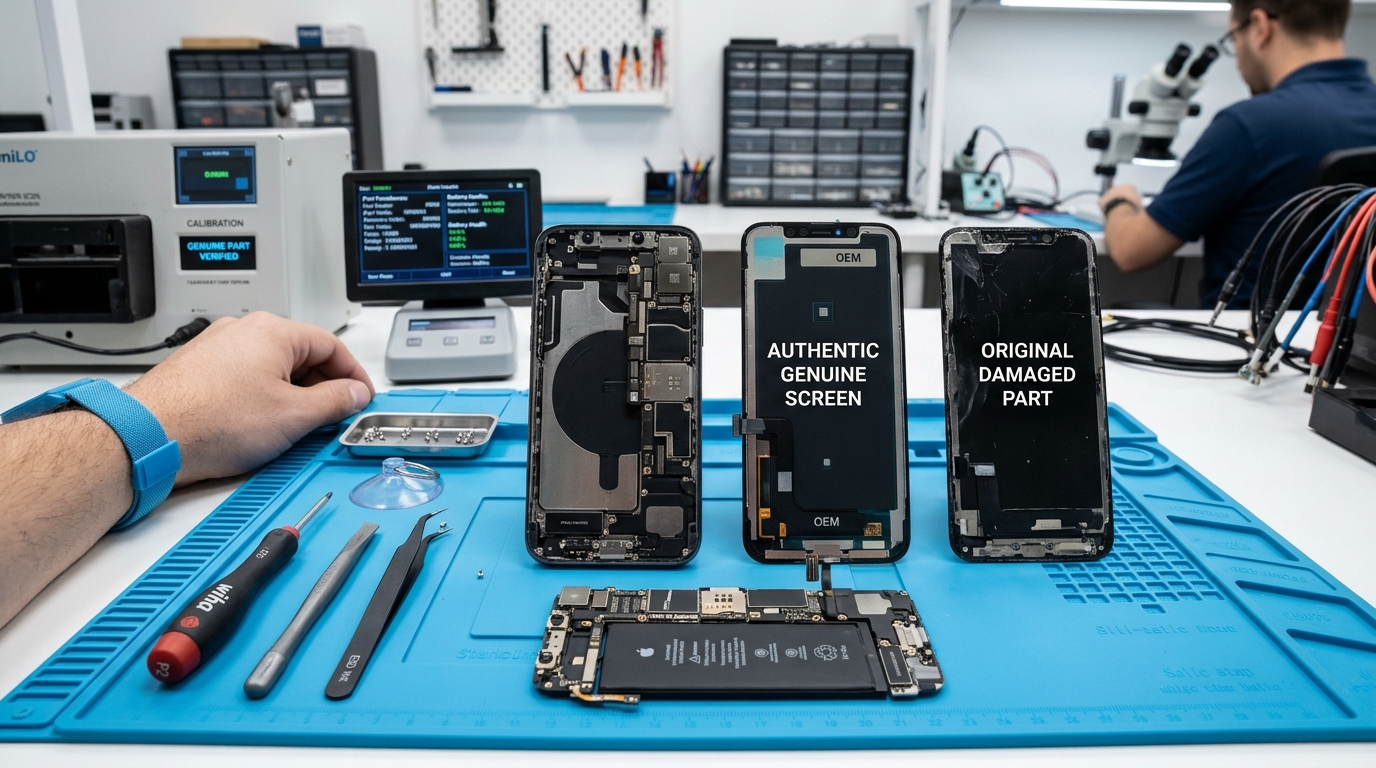
What This Post Covers:
- You will learn exactly what separates genuine parts from local parts in a phone repair.
- You will see a direct comparison across quality, cost, and long-term reliability.
- You will get a clear, no-hedge recommendation on which to choose and when.
- You will learn how to check which grade of part is actually being used.
- You will know when a local part is a reasonable trade-off.
Your phone needs a new screen or battery, and the provider offers two options at two different prices, without explaining what actually separates them. That gap is rarely just markup. Genuine vs local parts for phone repair is a real quality decision, not just a budget one, and picking blindly can mean a part failing again within months. This guide compares the two options directly in terms of quality, cost, and durability, so you know exactly what you are choosing between before you approve any repair.
Symptom-to-Solution Matrix
| Problem / Question | Root Cause / Reason | Answer / Solution |
|---|---|---|
| Quote has two very different price options | One option is genuine, the other is local | Ask which grade each price refers to |
| Local part fails again within weeks | Compatible parts vary widely in build quality | Request a genuine part replacement instead |
| Unsure what OEM or compatible means | Sourcing terms are not always explained clearly | Ask the provider to define the part grade |
| Screen colours look slightly off after repair | Local displays can vary in colour calibration | Compare against the original screen before accepting |
| Repair is out of warranty and budget matters | Genuine parts usually cost more upfront | Weigh cost against expected part lifespan |
What Is the Real Difference Between Genuine and Local Parts?
Genuine parts are sourced to match the original manufacturer specification, while local parts are compatible alternatives built to fit but not always to the same standard.
- Build consistency: Genuine parts are manufactured to a fixed specification, while local parts vary by supplier.
- Calibration: Displays and cameras from genuine sources typically match original colour and performance more closely.
- Longevity: Genuine parts generally hold up longer under daily use than lower-grade compatible alternatives.
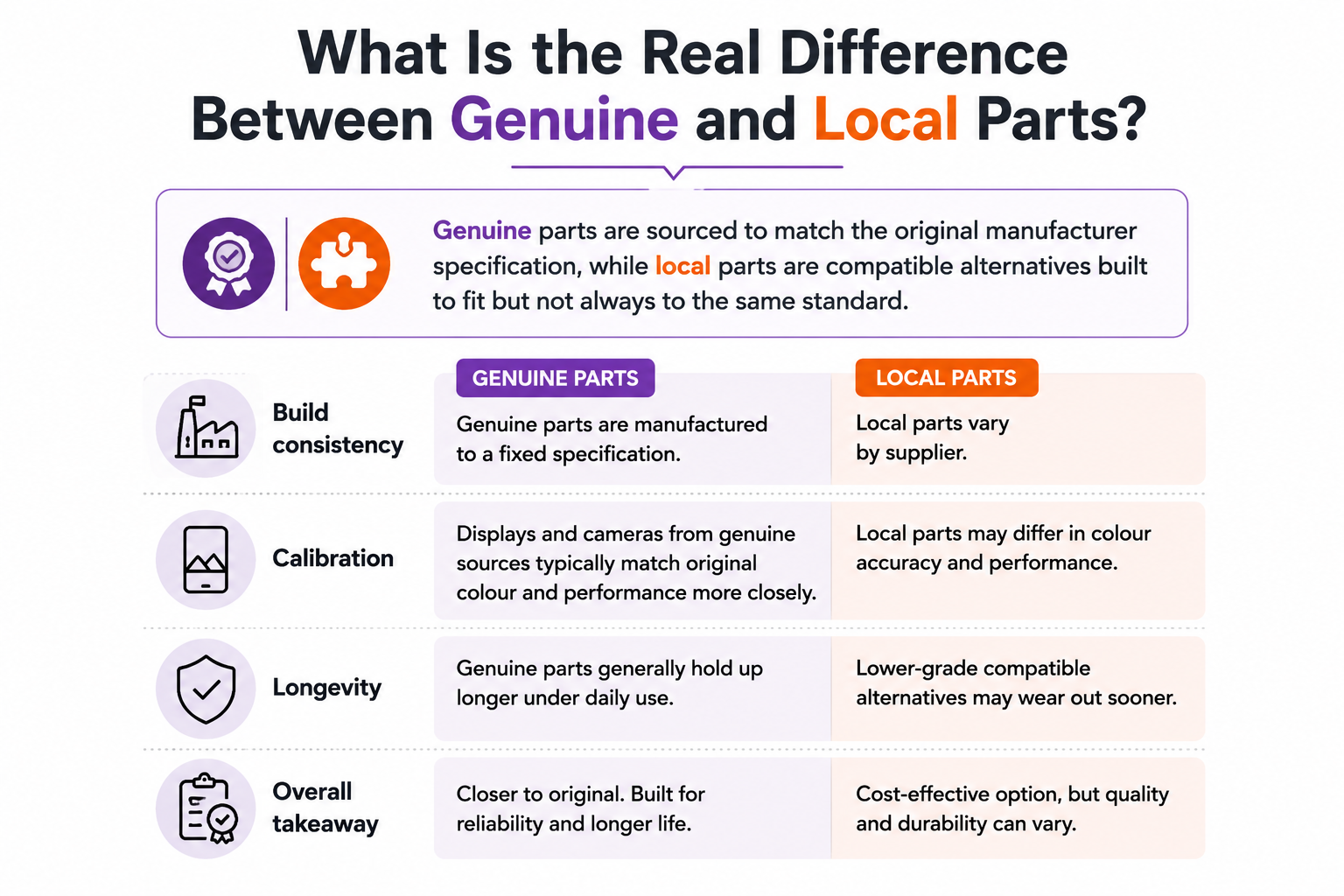
Not every local part is poor quality, and not every genuine part is flawless, but the consistency gap between the two categories is real and worth understanding. According to a NASSCOM industry note on device servicing, consistent part quality is repeatedly linked to longer device lifespan, reinforcing why sourcing matters as much as the repair itself.
Key Takeaways
- Genuine vs local parts phone repair is a quality decision, not only a pricing decision.
- Genuine parts are built to original specification, while local parts vary in quality by supplier.
- Screens and batteries show the clearest difference between genuine and local sourcing.
- A lower price on a local part often reflects a shorter expected lifespan.
- Always ask the provider directly which grade of part is being used before approving a repair.
Genuine or Local Parts: Which Should You Choose?
Genuine parts are the stronger choice for screens, batteries, and any component tied to safety or daily reliability.
| Criteria | Genuine Parts | Local Parts |
|---|---|---|
| Build consistency | Matches original specification | Varies by supplier |
| Typical lifespan | Generally longer | Often shorter |
| Upfront cost | Usually higher | Usually lower |
| Best suited for | Screens, batteries, safety-linked parts | Lower-stakes, budget-driven repairs |
For screens, batteries, and anything tied to safety or daily reliability, genuine parts are the clearer choice, since consistency and lifespan matter more than the upfront saving. Local parts can be a reasonable trade-off for lower-stakes repairs where budget drives the decision and expectations are set accordingly. This is not a blanket rule against local parts. It is a recommendation to match the part grade to what is actually at stake.
How Do You Check What Part Grade You Are Actually Getting?
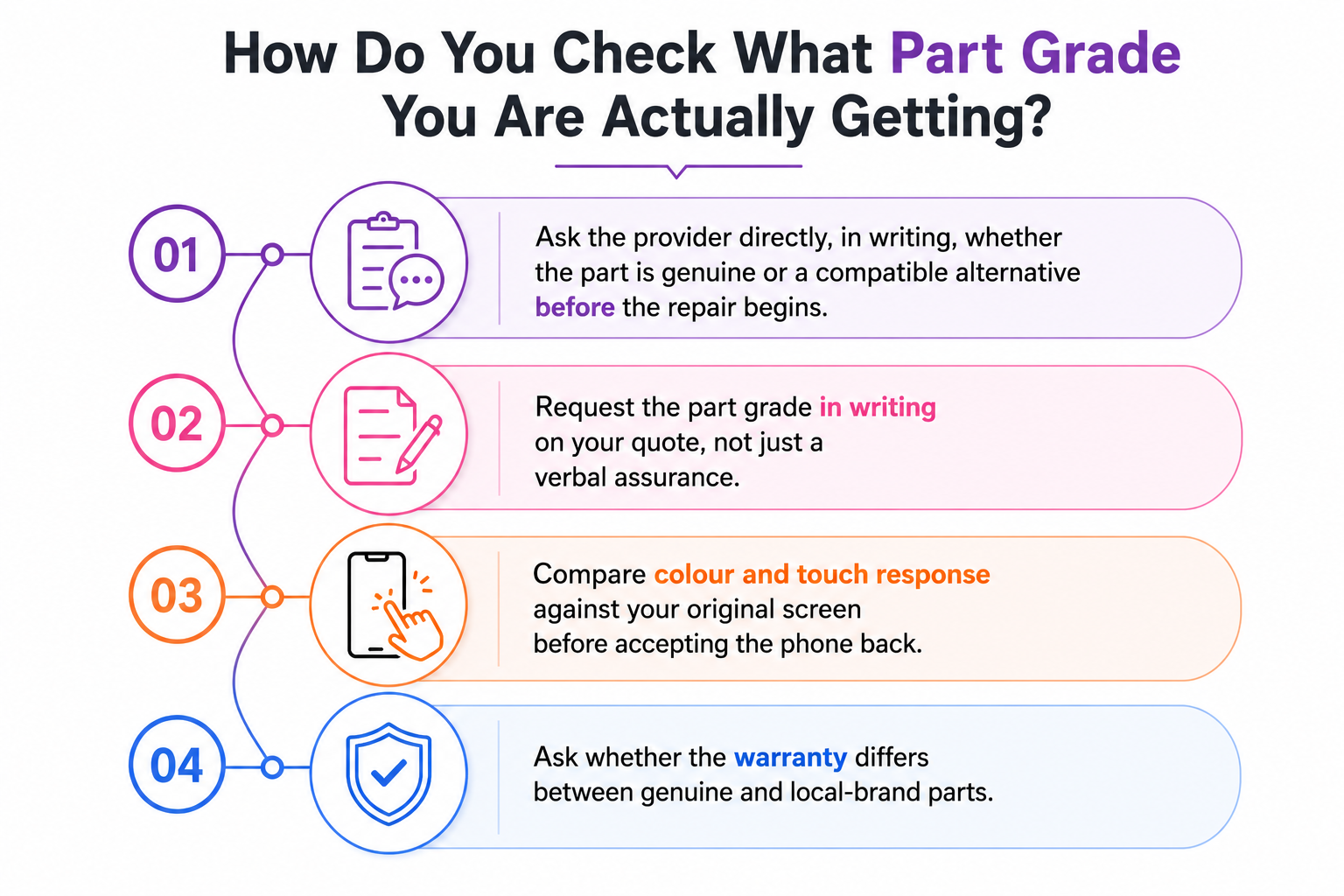
Ask the provider directly, in writing, whether the part is genuine or a compatible alternative before the repair begins.
- Request the part grade in writing on your quote, not just a verbal assurance.
- Compare colour and touch response against your original screen before accepting the phone back.
- Ask whether the warranty differs between genuine and local-brand parts.
A provider confident in their sourcing will answer these questions without hesitation. Reluctance to specify is itself useful information.
Practitioner's Observation: We can usually tell a local display within seconds under natural light, since the whites appear slightly warmer or cooler than the original panel. Customers rarely notice indoors, but it shows up the first time they check their phone outside, which is why we flag the difference before the repair, not after.
When Is a Local Part a Reasonable Choice?
Local parts are not always the wrong choice. For an older phone nearing the end of its practical life, or a lower-stakes fault like a scratched back panel, a local part can be a sensible trade-off. The distinction matters most for screens, batteries, and anything that affects safety or daily reliability.
Match the Part to What Is Actually at Stake
The price difference between two repair quotes is rarely just markup. It usually reflects a real difference in build consistency and expected lifespan. Ask directly which grade of part you are being offered, and weigh that against how long you plan to keep the phone. Genuine vs local parts phone repair is a decision worth five minutes of questions before you approve any quote.
At GoFix, we believe in complete transparency. Whether you need a mobile screen replacement or a high-capacity battery replacement, our certified technicians explain every part option and provide warranty-backed repairs so you get lasting reliability.
Frequently Asked Questions
- What is the real difference in genuine vs local parts phone repair?
Genuine vs local parts phone repair comes down to build consistency and lifespan. Genuine parts match the original manufacturer specification, while local parts are compatible alternatives that vary by supplier. Genuine parts typically last longer, particularly for screens and batteries, though they usually cost more upfront. - What does OEM vs compatible parts actually mean?
OEM vs compatible parts describes the same distinction as genuine versus local. OEM parts are made to the original specification, while compatible parts are built to fit but not always to the same build standard. Ask your provider directly which category a quoted part falls into. - Is there a local parts phone repair risk worth knowing about?
Yes, the main local parts phone repair risk is inconsistent build quality, which can show up as dimmer displays, shorter battery life, or an earlier repeat repair. Not every local part fails, but the variability is real. Weigh this risk against your budget and the length of time you plan to keep the phone. - What is the average lifespan difference between genuine and local screens?
The average lifespan difference favours genuine screens, which are built to a fixed specification and tend to hold colour and touch response longer under daily use. Local screens vary more by supplier, so results differ case by case. Ask your provider for their experience with the specific part before deciding. - How to check part quality before accepting a phone repair?
Ask how to check part quality by requesting the part grade in writing and comparing colour and touch response against your original screen once the repair is done. A provider confident in their sourcing will answer clearly. Hesitation or vague answers are themselves a useful warning sign.